How to Verify Property Documents Before Buying Land in India (2026 Guide)
Introduction
Buying land can be one of the best investments you make, but it can also become one of the biggest financial mistakes if proper document verification is ignored.
Every year, thousands of buyers lose money because they purchase land with ownership disputes, fake documents, pending loans, government acquisition issues, or unauthorized layouts.
Many people focus only on location, road access, and price while ignoring the legal status of the property. Unfortunately, a beautiful plot with legal problems can create years of stress and financial loss.
In my experience as a real estate professional, document verification is the most important step before paying even a small advance amount.
This guide explains how to verify property documents before buying land in India, helping you reduce risks and make informed investment decisions.
By the end of this article, you will know:
- Which documents must be verified
- How to confirm ownership
- How to check for legal disputes
- How to verify government approvals
- Common mistakes buyers should avoid
Table of Contents
- Why Property Verification Matters
- Essential Documents to Check
- Step-by-Step Property Verification Process
- Encumbrance Certificate Verification
- RERA and Layout Approval Checks
- Real-Life Example
- Common Mistakes Buyers Make
- Property Verification Checklist
- Frequently Asked Questions
- Final Conclusion
Why Property Verification Matters
Before investing in land, buyers must ensure that the seller has the legal authority to transfer ownership.
Property verification helps identify:
- Ownership disputes
- Fake registrations
- Pending loans
- Court cases
- Government acquisition notices
- Unauthorized layouts
- Missing approvals
A few hours spent verifying documents can save lakhs of rupees later.
Essential Documents to Check Before Buying Land
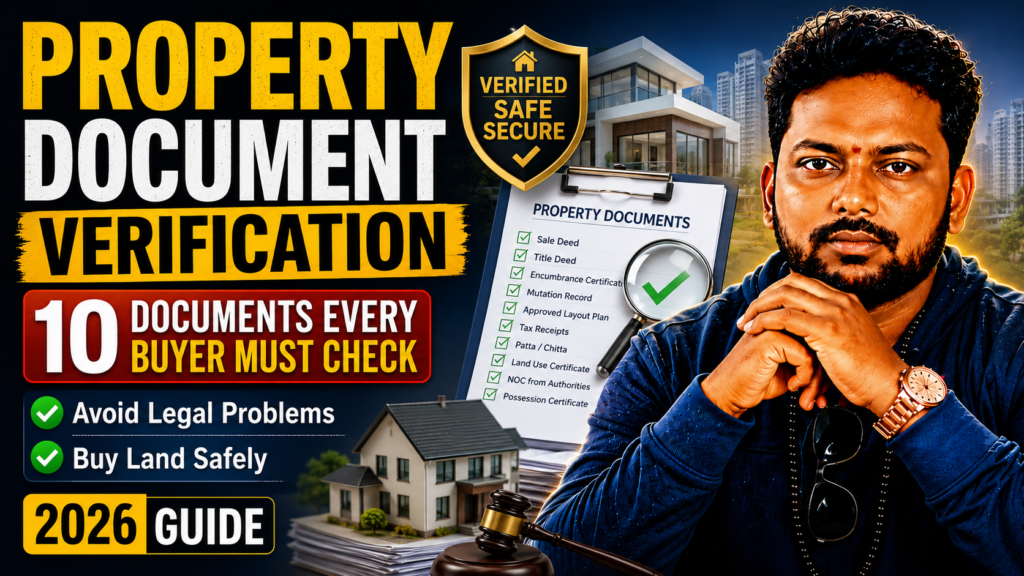
1. Sale Deed
The Sale Deed is one of the most important property documents.
Verify:
- Seller’s name
- Property description
- Survey number
- Boundaries
- Registration details
The seller’s information should match government records.
2. Title Deed
A clear title confirms ownership.
Check:
- Ownership history
- Previous transfers
- Legal claims
- Inheritance records
A property with a clear title is generally safer to purchase.
3. Encumbrance Certificate (EC)
The Encumbrance Certificate helps identify:
- Existing loans
- Mortgages
- Financial liabilities
- Previous transactions
A clean EC generally indicates that the property is free from registered financial encumbrances.
Related Guide
Read:
How To Check EC Online In Andhra Pradesh
4. Property Tax Receipts
Verify whether property taxes are paid regularly.
Check:
- Latest tax receipts
- Outstanding dues
- Property assessment details
Pending taxes may become the buyer’s responsibility after purchase.
5. ROR 1B / Revenue Records
Revenue records help confirm ownership and land classification.
Verify:
- Owner name
- Survey number
- Land extent
- Classification details
These records are particularly important for agricultural land purchases.
6. Mutation Records
Mutation records indicate whether ownership changes have been updated in government records.
Verify that the current owner’s name appears correctly.
Step-by-Step Property Verification Process
Step 1: Verify Seller Identity
Request:
- Aadhaar Card
- PAN Card
- Address Proof
Ensure the seller’s details match the property documents.
Step 2: Check Ownership History
Review ownership records for the previous 30 years whenever possible.
This helps identify:
- Disputes
- Fraudulent transfers
- Missing ownership links
Step 3: Verify Encumbrance Certificate
Obtain an EC covering the last 30 years.
Review:
- Registered transactions
- Loans
- Mortgages
Step 4: Check Survey Numbers
Verify:
- Survey number
- Extent
- Boundaries
Cross-check these details with government records.
Step 5: Verify Layout Approval
For plotted developments, verify whether the layout has approval from the appropriate authority.
Examples include:
- DTCP
- VMRDA
- HMDA
- Municipal Authorities
Never rely solely on the seller’s verbal claims.
Step 6: Conduct a Physical Site Visit
Verify:
- Access roads
- Boundaries
- Encroachments
- Neighboring properties
Physical inspection often reveals issues that documents cannot.
RERA and Layout Approval Verification
Many buyers assume every project is RERA approved.
Always verify independently.
Check:
- Project registration
- Developer details
- Completion timelines
- Approved plans
Related Article
Read:
RERA Guide 2026: What Every Property Buyer Must Know
Real-Life Example
Consider a buyer purchasing a plot for ₹15 lakh.
The seller provides a Sale Deed and tax receipts.
However, after obtaining an Encumbrance Certificate, the buyer discovers that the land is mortgaged to a bank.
Without this verification, the buyer could have inherited a serious legal problem.
This example highlights why document verification should never be skipped.
Common Mistakes Buyers Should Avoid
Paying Advance Before Verification
Never pay a large advance amount before checking documents.
Trusting Verbal Assurances
Always verify information independently.
Ignoring Encumbrance Certificate
Many buyers skip EC verification and later discover financial liabilities.
Buying Based Only on Price
Cheap land often requires additional investigation.
Skipping Legal Review
Consulting a property lawyer may help identify hidden risks.
Property Verification Checklist
| Document | Verified |
|---|---|
| Sale Deed | □ |
| Title Deed | □ |
| Encumbrance Certificate | □ |
| Tax Receipts | □ |
| ROR 1B Records | □ |
| Mutation Records | □ |
| Layout Approval | □ |
| Seller Identity | □ |
| Physical Inspection | □ |
| Legal Review | □ |
Save this checklist before making any property purchase.
Expert Tip
In my experience, buyers often spend months comparing prices but only a few minutes checking documents.
The safer approach is the opposite.
A legally clear property is usually a better investment than a cheaper property with uncertain documentation.
Frequently Asked Questions
What is the most important document before buying land?
The Sale Deed and Title Deed are among the most important ownership documents.
How do I check if a property has a loan?
Review the Encumbrance Certificate and verify records with the seller.
Is EC verification mandatory?
It is strongly recommended before purchasing property.
How many years of property history should be checked?
Many legal professionals recommend reviewing ownership records for around 30 years.
Can I verify documents online?
Many states provide online access to EC, land records, and registration data.
Should I hire a lawyer for verification?
For high-value transactions, professional legal review is often advisable.
What if survey numbers do not match?
Do not proceed until discrepancies are resolved.
Is layout approval important?
Yes. Purchasing land in unauthorized layouts can create future complications.
Related Articles
- How To Check EC Online In Andhra Pradesh
- RERA Guide 2026
- Property Registration Charges Guide
- Construction Cost Per Square Foot Guide
Final Conclusion
Property document verification is one of the most important steps before purchasing land in India.
A property may look attractive and be available at a competitive price, but without proper legal verification, it can become a costly mistake.
Before making any payment, verify ownership records, Encumbrance Certificates, tax receipts, approvals, survey details, and seller credentials.
A careful buyer spends time verifying documents before investing.
The goal is not just to buy land — it is to buy land safely and legally.