Property Buying Checklist India 2026 – Complete Step-by-Step Guide
Property Buying Checklist in India: Documents & Due Diligence Before You Buy
By Bandaru Narendra, Common Man Properties — Visakhapatnam
Buying property in India is one of the biggest financial decisions you will ever make. Whether it’s a flat, independent house, or land, even a small mistake can cost you lakhs or lead to long-term legal problems.
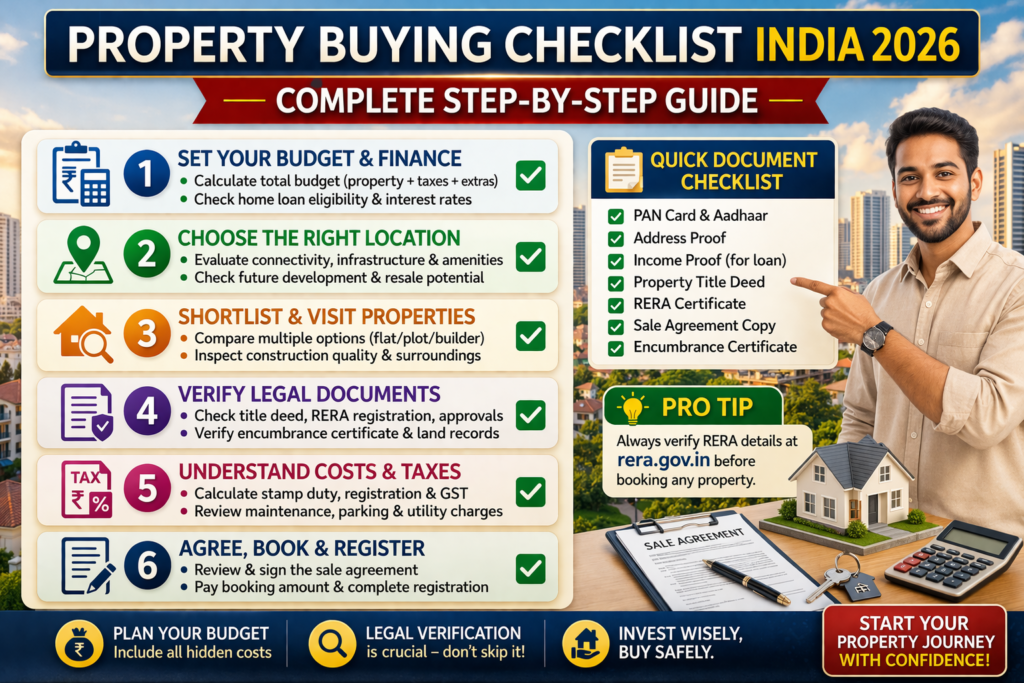
Buying a house, flat or plot is not simply a matter of finding the right price and paying the seller. Before you commit a substantial amount of money, you need to establish that the seller has the right to sell, the property is properly documented, applicable approvals are in place, the physical property matches the documents, and the total cost fits your budget.
This property buying checklist in India is designed to help you go through those checks in a logical order.
It covers the major stages of a property purchase—from deciding your budget and checking the location to verifying title, Encumbrance Certificate (EC), approvals, RERA, taxes, physical condition, agreement and registration.
Important: Property laws, government charges, approval requirements and procedures can differ between states and property types. This is general educational information, not individual legal advice. For a high-value or legally complex transaction, have the documents reviewed by a qualified property lawyer or other appropriate professional.
Quick Property Buying Checklist
Before purchasing a property, work through this list:
- Define the purpose of buying
- Calculate the complete budget
- Check the location
- Compare similar properties
- Verify seller identity
- Verify ownership and title
- Examine previous title documents
- Check the Encumbrance Certificate
- Check relevant land/revenue records
- Verify applicable layout approvals
- Check building permissions where applicable
- Check RERA registration where applicable
- Check completion/occupancy documents where applicable
- Check property tax and other dues
- Physically inspect the property
- Verify measurements and boundaries
- Calculate stamp duty and registration-related costs
- Check loan eligibility if financing
- Put important terms in writing
- Review the agreement before signing
- Pay token/advance only after appropriate checks
- Complete registration properly
- Complete relevant post-registration transfers
The rest of this guide explains these checks.
1. Decide Why You Are Buying
Start by identifying the purpose of the purchase.
You may be buying for:
- Self-use
- Rental income
- Long-term investment
- Future construction
- Retirement
- Family requirements
- Business or commercial use
Your purpose affects almost every later decision.
For example, a family buying a home for daily use may prioritise schools, hospitals, commutes and neighbourhood facilities.
An investor may place greater emphasis on rental demand, liquidity, development activity and the relationship between purchase price and expected returns.
Do not choose the property first and decide its purpose later.
2. Set Your Total Property Budget
Do not calculate your budget using only the advertised property price.
The complete purchase cost can include:
| Cost | What to check |
|---|---|
| Property price | Negotiated consideration |
| Stamp duty | State-specific and transaction-specific |
| Registration charges | Applicable government charges |
| Legal fees | Document/title review |
| Broking | If applicable |
| Loan charges | If financed |
| GST | May apply in applicable transactions |
| Maintenance deposits | Particularly for some apartments/projects |
| Repairs/interiors | Depends on property condition |
| Moving costs | For residential purchases |
| Other charges | Depends on property/project |
RBI housing-finance guidance states that banks should not include stamp duty, registration and documentation charges in the financed property cost for LTV purposes, subject to specified exceptions.
That is one reason buyers should maintain funds beyond the amount planned for the property itself.
A better budget formula
Think in terms of:
Purchase price + transaction costs + immediate property expenses + financial reserve
rather than:
Purchase price = total budget
Do not use every rupee of your savings simply to complete the purchase.
3. Check the Location
A property can have excellent documentation and still be a poor purchase if the location does not suit your purpose.
Check:
- Road connectivity
- Public transport
- Schools
- Hospitals
- Employment centres
- Markets
- Water supply
- Drainage
- Electricity
- Internet connectivity
- Traffic
- Noise
- Surrounding development
- Flooding or other local risks
- Future infrastructure
Do not rely only on future promises.
Statements such as:
“A major project is coming here.”
or
“Prices will definitely double.”
should not be treated as facts unless you can independently verify the relevant information.
For Andhra Pradesh buyers, location-specific planning and development information should be checked with the appropriate authority.
4. Verify the Property Type and Measurements
The checklist changes depending on whether you are buying:
- Flat/apartment
- Independent house
- Villa
- Residential plot
- Agricultural land
- Commercial property
Check the measurement used in advertisements against the relevant property documents.
For apartments, understand the difference between terms such as:
- Carpet area
- Built-up area
- Saleable/super built-up area
- Undivided share of land, where applicable
For plots and land, verify:
- Survey number
- Extent
- Boundaries
- Road access
- Shape
- Physical measurements
- Relevant land records
If the property documents and the physical property do not appear to match, stop and investigate before proceeding.
5. Verify Ownership and Title
This is one of the most important checks in the entire transaction.
The basic question is:
Does the person selling the property actually have the legal right to sell it?
Do not rely solely on the seller’s statement or a broker’s assurance.
Examine the title documents.
Depending on the property, the relevant document history may include:
- Current sale deed
- Previous sale deeds
- Gift deed
- Partition deed
- Settlement deed
- Release deed
- Inheritance-related documents
- Court orders, where applicable
- Other documents establishing the chain of ownership
The exact documents depend on how the property was acquired.
Seller verification
Check the seller’s identity against the transaction documents.
If there are multiple owners, ensure that the transaction is being executed by the people who are legally required to execute it.
If the seller is acting through a power of attorney, the authority and validity of that arrangement should be independently verified.
The Andhra Pradesh government’s APNRT guidance specifically notes that ownership is not transferred merely through a general power of attorney and that purchasers should obtain a registered sale deed for transfer.
If the title is complicated
Extra caution is necessary when the property involves:
- Inheritance
- Multiple heirs
- Minor interests
- Partition disputes
- Pending litigation
- Power of Attorney
- Company ownership
- Trust or society ownership
- Government land
- Assigned land
- Restricted/prohibited property
These are situations where independent legal review becomes particularly important.
6. Check the Encumbrance Certificate.
An Encumbrance Certificate (EC) is an important document used in property due diligence.
It can provide information about registered transactions or encumbrances recorded against the property for the period covered by the certificate.
Depending on the transaction, you may need to examine an appropriate historical period rather than automatically assuming that a fixed number of years is sufficient.
What to look for
Check whether the relevant records indicate:
- Registered sale transactions
- Mortgages/registered charges
- Releases
- Other registered encumbrances
What an EC DOES NOT mean
Do not treat an EC as a complete guarantee that the property has no legal problem.
An EC is only one component of title due diligence.
A complete review may also require examination of:
- Title chain
- Revenue records
- Court/litigation information where relevant
- Seller’s authority
- Approvals
- Physical possession
- Other property-specific records
7. Check Revenue and Land Records
For land and plot transactions, revenue and land records can be particularly important.
Depending on the state and property, relevant records may include:
- Record of Rights
- Land ownership records
- Survey records
- Cadastral maps
- Mutation records
- Land classification
- Other state-specific revenue records
For Andhra Pradesh, Bhunaksha AP is the government’s cadastral mapping platform and is integrated with land-record systems and the MeeBhoomi ecosystem.
These records can help you compare the documentary description of the land with the mapped/recorded parcel.
However, online records should not be treated as a substitute for complete legal verification.
8. Check Layout and Planning Approvals
This is particularly important when buying a plot or property in a developed layout.
Do not simply accept:
“DTCP approved”
or
“Authority approved”
as sufficient information.
Identify the actual competent authority for that location and verify the relevant approval.
Depending on location and property type, the applicable authority and approval can differ.
Check, where applicable:
- Layout approval
- Development permission
- Road access
- Open-space provisions
- Plot number
- Survey numbers
- Approved layout plan
- Land-use permissions
- Conversion requirements, where applicable
For Andhra Pradesh properties, do not automatically assume that one authority’s approval applies statewide.
9. Check RERA Registration Where Applicable
If you are buying an apartment, villa, plot or other property in a real estate project that falls within the scope of RERA, verify the project through the relevant state RERA authority.
Section 3 of the Real Estate (Regulation and Development) Act, 2016, generally requires qualifying real estate projects to be registered before advertising, marketing, booking or offering them for sale, subject to statutory provisions and exemptions.
What should you check?
Where applicable, verify:
- RERA registration number
- Promoter details
- Project status
- Proposed completion date
- Project approvals
- Litigation information disclosed on the portal
- Project land details
- Available units
- Other information published by the authority
The Andhra Pradesh RERA project portal provides project information, including registration details, project status, completion information, land area and project-related disclosures.
Important
Do not assume:
RERA registered = everything is automatically safe.
RERA verification is one part of the broader due-diligence process.
10. Check Building Approvals and Completion Documents
For an existing house, apartment or other constructed property, check the documents relevant to the building.
Depending on the property, these may include:
- Building permission
- Sanctioned building plan
- Completion Certificate
- Occupancy Certificate
- Approved modifications
- Other local-authority permissions
The exact requirement depends on the property, location and applicable regulations.
Compare documents with the actual building.
Do not stop at checking whether a document exists.
Ask:
Does the actual building broadly correspond to the approved/sanctioned information?
Unauthorised construction or major deviations can create problems involving financing, resale, regularisation and local-authority compliance.
11. Check Property Tax and Outstanding Dues
Before completing the transaction, check applicable outstanding amounts.
Depending on the property, examine:
- Property tax
- Electricity dues
- Water charges
- Maintenance dues
- Apartment association/society dues
- Other local charges
Get clarity on who will clear any outstanding amount before or at the time of completion.
Keep receipts and supporting documents.
12. Inspect the Property Physically
Never buy property based only on photographs, videos or a brochure.
Visit the property.
Check the actual property.
For land:
- Survey number
- Boundaries
- Road access
- Physical extent
- Neighbouring properties
- Drainage
- Water
- Electricity
- Encroachments
- Ground conditions
For houses/flats:
- Construction condition
- Cracks
- Seepage
- Plumbing
- Electrical systems
- Ventilation
- Parking
- Common areas
- Water supply
- Drainage
- Access
Speak to people nearby.
Where practical, speak with neighbours or local residents.
They may provide useful information about:
- Water problems
- Drainage
- Access disputes
- Flooding
- Noise
- Boundary disputes
- Local development
This does not replace documentary verification, but it can reveal issues that a brochure will never mention.
13. Compare the Market Price
Do not decide that a property is a good deal simply because the seller offers a “discount”.
Compare similar properties in the same micro-market.
Look at:
- Price per square foot
- Plot price per square yard where relevant
- Property age
- Road width
- Floor
- Parking
- Construction quality
- Location
- Amenities
- Approval status
- Property condition
For example, a ₹5 lakh cheaper property may not actually be cheaper if it has poorer access, inferior construction or unresolved documentation issues.
The goal is not to find the cheapest property.
The goal is to determine whether the price is reasonable for the property you are actually buying.
14. Calculate the Complete Purchase Cost
Never calculate your budget using the property price alone.
Potential costs include:
| Cost category | What to verify |
|---|---|
| Property price | Final negotiated consideration |
| Stamp duty | Applicable state rules |
| Registration fee | Applicable state rules |
| Transfer-related charges | Where applicable |
| Legal fees | Lawyer/document review |
| Broking | If applicable |
| Loan charges | If financed |
| GST | Where applicable |
| Maintenance/deposits | Project-specific |
| Repairs/interiors | Property-specific |
Why avoid one national percentage?
There is no single percentage that accurately represents every property purchase across India.
Government charges differ by state, transaction type and circumstances.
For example, the Andhra Pradesh Registration and Stamps Department confirms that the state collects stamp duty, transfer duty and registration fees and provides the official registration system for property transactions.
For an Andhra Pradesh transaction, verify the current charges through the official registration system before calculating the final amount.
You can also refer to our dedicated Stamp Duty in Andhra Pradesh guide for the state-specific discussion while independently verifying current charges before registration.
15. Check Home Loan and Payment Arrangements
If you are using a home loan:
- Check your loan eligibility
- Compare lenders
- Understand the interest rate
- Check the tenure
- Calculate the EMI
- Understand processing charges
- Check prepayment conditions
- Understand the lender’s property-verification process
Important distinction
A bank approving a loan does not mean you can skip your own legal due diligence.
The bank is assessing the property and borrower for its lending decision.
You are making a much broader decision about ownership, suitability and long-term financial risk.
16. Before Paying Token Advance
This is one of the stages where buyers can make expensive mistakes.
Before paying a substantial token or advance, try to establish at least the basic facts:
- Who owns the property?
- What is the agreed price?
- What property is being sold?
- Are there known encumbrances?
- Are there multiple owners?
- Is the seller authorised to sell?
- What happens if the transaction does not proceed?
- When will the remaining amount be paid?
- What documents are still pending?
Always obtain a written receipt.
The receipt should clearly identify the transaction and amount paid.
Where appropriate, the written terms should also explain whether and when the amount is refundable.
Do not rely on:
“Don’t worry, we’ll put everything in the sale deed later.”
Important commercial terms should be documented properly.
17. Review the Agreement
Before signing an agreement for sale or similar transaction document, read it carefully.
Depending on the transaction, check:
- Names of parties
- Property description
- Survey/plot/unit details
- Sale consideration
- Payment schedule
- Possession terms
- Default provisions
- Cancellation provisions
- Existing dues
- Included fixtures/fittings
- Parking terms
- Completion obligations
- Registration obligations
- Other negotiated terms
For larger transactions, independent legal review is strongly advisable.
For RERA-regulated projects, the central law also contains specific provisions concerning agreements for sale and restrictions on promoters taking deposits/advances before entering into the prescribed agreement.
18. Complete Registration
Registration is an important formal stage of a property transaction.
Before registration, verify that:
- The parties are correctly identified
- The property description is accurate
- Consideration is correctly recorded
- Applicable government charges are understood
- Required documents are available
- The document reflects the agreed transaction
The Andhra Pradesh Registration and Stamps Department explains that registration creates recorded information available for public verification and preserves records relating to registered documents.
Do not make this mistake
Do not think:
“Once it is registered, I don’t need to worry about the documents.”
Registration should come after appropriate due diligence, not instead of due diligence.
19. Post-Purchase Checklist
After completing the transaction, keep the paperwork organised.
Depending on the property and local procedures, consider:
- Collect registered documents
- Secure original documents
- Create digital backups
- Update applicable land/property records
- Complete mutation/name transfer where applicable
- Transfer electricity connection where applicable
- Transfer water connection where applicable
- Inform apartment association/society where applicable
- Keep tax receipts
- Keep loan documents
- Keep possession documents
Do not throw away old receipts and transaction records.
Red-Flag Checklist: When Should You Stop the Deal?
Be extremely cautious if you encounter any of the following:
Ownership red flags
- The seller’s name does not match the documents
- Multiple heirs are involved, but some are absent
- Seller cannot explain the title chain
- Power of Attorney is unclear
- Ownership dispute is disclosed
Document red flags.
- Original documents are unavailable without a reasonable explanation
- Important documents contain inconsistent property details
- Survey number does not match
- Extent differs between documents
- Boundaries do not match
Approval red flags
- Layout approval cannot be independently verified
- Building permission is unclear
- Applicable RERA registration cannot be verified
- Major construction differs from approved information
Financial red flags
- Seller demands unexplained cash
- A large token amount is demanded immediately
- Refund conditions are not documented
- Seller refuses a written agreement
Physical red flags
- Encroachment
- Blocked access
- Boundary dispute
- Drainage problems
- Water problems
- Major structural concerns
If a serious issue appears, do not let urgency or emotional attachment force you into the transaction.
House, Flat and Plot: What Changes in the Checklist?
| Check | Flat | Independent House | Plot |
|---|---|---|---|
| Title | ✓ | ✓ | ✓ |
| EC | ✓ | ✓ | ✓ |
| RERA where applicable | ✓ | Sometimes | Sometimes |
| Building approval | ✓ | ✓ | Usually not applicable in the same form |
| Layout approval | Project-specific | Location-specific | ✓ |
| Physical inspection | ✓ | ✓ | ✓ |
| Survey/boundaries | Important | Important | Critical |
| Property tax | ✓ | ✓ | Applicable depending on property |
| Occupancy/completion documents | Where applicable | Where applicable | Usually not applicable in the same form |
| Revenue/land records | Important | Important | Critical |
| Road access | Important | Important | Critical |
There is no single checklist that fits every property exactly.
The core due diligence remains the same, but the documents and approvals change according to the property.
Property Buying Checklist — Printable Version
Financial
- Total budget calculated
- Down payment arranged
- Emergency reserve maintained
- Loan eligibility checked
- Transaction costs calculated
Seller
- Seller identity verified
- Seller’s ownership verified
- All required owners identified
- Authority to sell verified
Legal
- Current title document checked
- Previous title documents checked
- EC checked
- Revenue/land records checked
- Litigation concerns investigated where relevant
- Property restrictions checked where relevant
Approvals
- Layout approval checked where applicable
- Building approval checked where applicable
- RERA checked where applicable
- Completion/occupancy documents checked where applicable
Physical
- Site visited
- Measurements checked
- Boundaries checked
- Road access checked
- Water checked
- Drainage checked
- Construction condition checked
Financial/Transaction
- Market price compared
- Total purchase cost calculated
- Token terms documented
- Agreement reviewed
- Registration charges verified
After Purchase
- Registered documents collected
- Digital copies created
- Mutation/name transfer checked
- Utility transfers completed where applicable
- Tax/association records updated where applicable
Frequently Asked Questions
What is the most important check before buying property?
There is no single document that replaces complete due diligence. Ownership/title verification is one of the most important checks, followed by verification of encumbrances, approvals, physical property and the seller’s authority to transfer the property.
Is an Encumbrance Certificate enough to prove clear title?
No.
An EC is an important part of property due diligence, but it should not be treated as a complete title investigation or litigation search.
How many years of EC should I check?
There is no universal “10-year” or “15-year” rule that applies to every transaction. The appropriate period should be determined based on the property’s title history, transaction and professional due diligence requirements.
Is RERA registration required for every property?
No. RERA contains statutory provisions and exemptions. For projects that fall within the registration requirements, the project should be verified through the relevant state RERA authority.
Should I visit the property before buying?
Yes.
Physical inspection can reveal issues involving boundaries, access, construction, drainage, water, surroundings and actual condition that may not be obvious from documents or photographs.
Should I pay a token amount before checking documents?
Avoid paying a substantial amount before carrying out appropriate basic verification. If a token is paid, obtain written terms and a clear receipt.
Are stamp duty and registration charges the same throughout India?
No.
They can differ according to state, transaction type, property and applicable government rules. Always check the current state-specific charges.
Does bank loan approval mean the property is legally safe?
No.
The lender’s due diligence is not a substitute for the buyer’s independent legal and physical verification.
What documents should I check before buying a plot?
Depending on the property and state, check the title chain, EC, relevant land/revenue records, survey details, boundaries, layout/planning approval, road access and other applicable permissions.
What should I check before buying an apartment?
Check the title/project documents, RERA registration where applicable, sanctioned plans, building permissions, completion/occupancy documentation where applicable, unit details, carpet area, payment terms, maintenance obligations and the agreement.
What to Remember Before Buying Property
A property purchase should not be based only on:
Price + location + emotion.
A safer framework is:
Purpose → Budget → Location → Property → Title → EC → Land/Revenue Records → Approvals → RERA → Physical Inspection → Market Price → Total Cost → Agreement → Registration → Post-Purchase Updates
The most important question is not:
“Is this property cheap?”
It is:
“Can I establish that this property is suitable, properly documented, appropriately approved and financially sensible for my situation?”
Take your time before paying a substantial amount.
A property that looks like a great deal can become expensive if ownership, approval, access, construction or documentation problems emerge later.
For significant transactions, particularly inherited property, disputed property, agricultural land, properties involving multiple owners, power of attorney transactions or properties with unusual documentation, obtain independent professional advice before proceeding.
Common Man Properties provides general real-estate information for real estate purposes. Government rules, fees and procedures can change. Verify current requirements with the relevant government authority and obtain professional advice where appropriate.