Land Area Conversion Chart India – Complete Land Measurement Guide
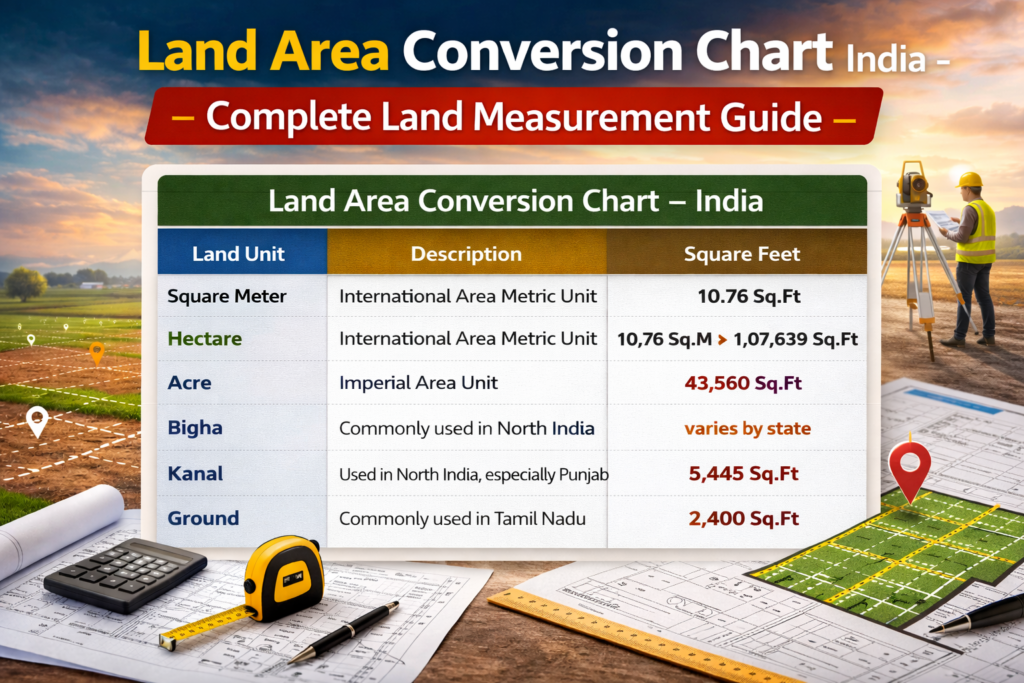
Understanding the land conversion chart in India is essential for anyone buying, selling, or investing in property. In India, land measurements vary depending on the region, and different units such as square feet, square yards, acres, hectares, cents, bigha, guntha, kanal, and marla are commonly used.
Because of these different measurement units, property buyers often get confused when comparing land sizes. Knowing how to convert one land unit into another helps investors calculate property value accurately and avoid misunderstandings during real estate transactions.
Whether you are purchasing open plots, residential land, farmlands, or agricultural property, understanding land area conversions can help you make smarter decisions.
This guide explains:
- Common land measurement units used in India
- Land area conversion chart
- Acre, hectare, cent, and square feet conversions
- Practical real estate examples
Let’s begin with the basics.
Common Land Measurement Units in India
Several land measurement units are used across India. The most common ones include:
- Square Feet (sq ft)
- Square Yard (sq yd)
- Acre
- Hectare
- Cent
- Bigha
- Guntha
- Kanal and Marla
Urban real estate projects generally use square feet or square yards, while agricultural land is often measured in acres or hectares.
Land Area Conversion Chart India
Below is a commonly used land conversion chart in India.
| Land Unit | Equivalent Conversion |
|---|---|
| 1 Square Yard | 9 Square Feet |
| 1 Cent | 435.6 Square Feet |
| 1 Guntha | 1,089 Square Feet |
| 1 Acre | 43,560 Square Feet |
| 1 Hectare | 107,639 Square Feet |
| 1 Acre | 100 Cents |
| 40 Guntha | 1 Acre |
| 1 Hectare | 2.471 Acres |
This table helps property buyers quickly compare land sizes.
Square Yard to Square Feet Conversion
One of the most commonly used conversions in real estate is the following:
1 Square Yard = 9 Square Feet
Example:
If a plot is 200 square yards, the total area in square feet is:
200 × 9 = 1,800 sq ft
Many residential plots are measured in square yards.
Acre to Square Feet Conversion
An acre is commonly used for measuring large land parcels.
1 Acre = 43,560 square feet.
Example:
2 acres land
2 × 43,560 = 87,120 sq ft
Farmlands and agricultural properties are often measured in acres.
Hectare to Acre Conversion
A hectare is a metric land measurement unit used in agriculture and government land records.
1 Hectare = 2.471 Acres
Example:
3 hectares land
3 × 2.471 = 7.413 acres
This conversion is often used for large farmland transactions.
Cent to Square Feet Conversion
“Cent” is commonly used in South India.
1 Cent = 435.6 Square Feet
Example:
10-cent land
10 × 435.6 = 4,356 sq ft
Small residential plots are often measured in cents.
Guntha to Square Feet Conversion
Guntha is a traditional land measurement unit used in Maharashtra, Karnataka, and Gujarat.
1 Guntha = 1,089 Square Feet
Also:
40 Guntha = 1 Acre
Example:
15 guntha land
15 × 1,089 = 16,335 sq ft
Kanal and Marla Conversion
Kanal and marla are commonly used in North India.
1 Kanal = 20 Marla
1 Marla = 272.25 Square Feet
Therefore:
1 Kanal = 5,445 Square Feet
These units are frequently used in Punjab and Haryana.
Real Estate Example
Suppose you want to buy a plot.
Plot size: 300 square yards
Convert into square feet:
300 × 9 = 2,700 sq ft
If the price per sq. ft. is ₹3,000:
Total property value = ₹8,100,000
Understanding land conversions helps buyers calculate property prices accurately.
Why Land Area Conversion Is Important
Accurate Property Valuation
Property prices are usually quoted per square foot, so conversions help determine the real cost.
Comparing Different Properties
Investors can compare land parcels measured in different units.
Legal Documentation
Land records may use different measurement systems depending on region.
Understanding conversions prevents confusion.
Explore Property Investment Opportunities
If you are looking for real estate investments, explore these property categories:
Apartment Flats
https://commonmanproperties.in/apartment-flats/
Independent Houses
https://commonmanproperties.in/houses/
Open Plots
https://commonmanproperties.in/open-plots/
Farmlands
https://commonmanproperties.in/farm-lands/
Understanding land measurement units helps investors compare property sizes easily.
Learn Real Estate Investment Basics
Before investing in land or property, it is important to understand legal checks and ROI calculations, as these factors can significantly impact the investment’s success and profitability.

Download the Real Estate Investment Tips for Beginners eBook (₹199):
https://rzp.io/rzp/realestateinvestingtipsembeds
This guide explains:
- ROI calculation
- Legal document verification
- Risk management
- Smart property investment strategies
Educating yourself before investing can prevent costly mistakes.
Frequently Asked Questions
What is the most common land measurement unit in India?
Square feet is the most commonly used unit in urban real estate.
How many square feet are in one acre?
1 acre equals 43,560 square feet.
How many cents are in an acre?
1 acre equals 100 cents.
What unit is used for agricultural land?
Agricultural land is often measured in acres or hectares.
Why do land measurements vary in India?
Different regions traditionally used their measurement systems.
Final Conclusion
Understanding the land area conversion chart in India is essential for property buyers, investors, and real estate professionals.
Since different regions use different land measurement units, knowing how to convert between them helps investors evaluate land size accurately and avoid confusion during property transactions.
Before purchasing land, always verify:
- Land measurement units
- Legal property documents
- Price per square foot
Proper knowledge ensures smarter and safer real estate investments.
FOR MORE INFORMATION – SEE THE FULL ARTICLE