How to Check Land Ownership Online in India (2026 Guide)
Buying land is one of the biggest financial decisions most people make. Unfortunately, property fraud, fake ownership claims, and disputed lands are still common in many parts of India. Before paying even a small advance amount, every buyer should verify who actually owns the land.
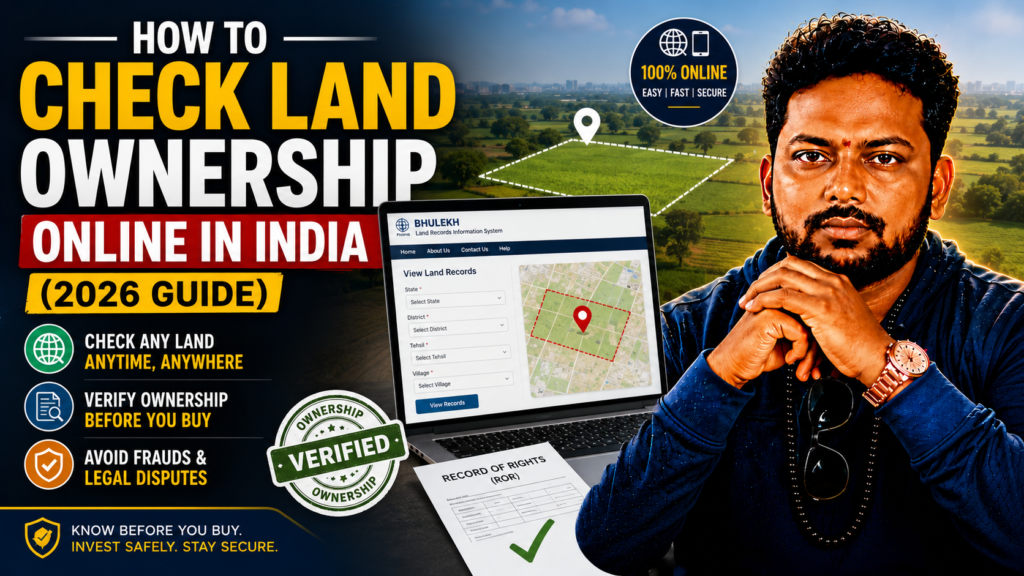
The good news is that most Indian states now provide online land record portals where citizens can check ownership details, survey numbers, land classifications, and revenue records.
In this guide, you’ll learn how to check land ownership online in India, which government websites to use, what documents to verify, and the mistakes buyers should avoid.
Table of Contents
- Why Checking Land Ownership Is Important
- Documents Required for Verification
- How to Check Land Ownership Online
- State-Wise Land Record Portals
- How to Verify Survey Numbers
- Red Flags to Watch Out For
- Online Verification vs Legal Verification
- Common Mistakes Buyers Make
- Frequently Asked Questions
- Conclusion
Why Checking Land Ownership Is Important
Verifying ownership helps you:
- Avoid property fraud
- Confirm the seller is the actual owner
- Identify legal disputes
- Verify survey numbers
- Check land classification
- Ensure smooth registration
As a real estate professional, I have seen many buyers lose money simply because they trusted verbal claims without checking official records.
A few minutes of verification can save years of legal problems.
Documents Required for Land Ownership Verification
Before starting, collect:
| Document | Purpose |
|---|---|
| Survey Number | Identifies the land parcel |
| Seller’s Name | Helps verify ownership |
| Aadhaar/PAN Copy | Identity verification |
| Sale Deed Copy | Ownership proof |
| Encumbrance Certificate | Checks liabilities |
| Pattadar Passbook (where applicable) | Land ownership details |
Step-by-Step: How to Check Land Ownership Online
Step 1: Visit Your State Land Records Portal
Every state has its own official land records website.
Some popular portals include:
| State | Portal |
|---|---|
| Andhra Pradesh | MeeBhoomi |
| Telangana | Dharani |
| Karnataka | Bhoomi |
| Tamil Nadu | Patta Chitta |
| Maharashtra | Mahabhulekh |
| Uttar Pradesh | Bhulekh |
| Odisha | Bhulekh Odisha |
Step 2: Select District, Mandal and Village
Choose:
- District
- Mandal/Taluk
- Village
Ensure these details exactly match the property location.
Step 3: Enter Survey Number
The survey number is the unique identification number assigned to a piece of land.
After entering the survey number, the portal generally displays:
- Owner name
- Survey number
- Extent of land
- Land classification
- Revenue details
Step 4: Verify Owner Details
Compare:
- Owner name in land records
- Owner name in sale deed
- Owner name in Aadhaar/PAN
All details should match.
Any mismatch requires further investigation.
Step 5: Check Mutation Records
Mutation records confirm whether ownership has been officially transferred after purchase.
If mutation is not updated, legal ownership issues may arise later.
How to Verify Survey Number Correctly
Many buyers verify only the owner name.
This is a mistake.
You should also verify:
- Survey Number
- Subdivision Number
- Total Land Area
- Boundary Details
- Village Records
Even a small survey number mismatch can create future disputes.
Check Encumbrance Certificate (EC)
An Encumbrance Certificate helps determine whether:
- Loans exist on the property
- Legal liabilities exist
- Court attachments exist
- Previous transactions are recorded
Never buy land without checking the latest EC.
Recommended period:
At least the last 15–30 years.
Online Verification vs Legal Verification
| Online Verification | Legal Verification |
|---|---|
| Checks basic ownership | Checks complete legal status |
| Quick and free | Paid service |
| Government records | Advocate examination |
| Initial verification | Final verification |
The safest approach is to use both.
Common Red Flags to Watch Out For
1. Seller Refuses to Share Documents
Immediate warning sign.
2. Name Mismatch
Owner name differs between records.
3. Survey Number Discrepancies
Survey numbers do not match official records.
4. Missing EC
No Encumbrance Certificate available.
5. Pending Court Cases
Property involved in legal disputes.
6. Agricultural Land Restrictions
Conversion permissions may be required.
Example
A buyer in Andhra Pradesh agreed to purchase a plot after seeing only photocopies of ownership documents.
When the survey number was checked through official records, it was discovered that the seller owned only part of the land.
The transaction was stopped before registration, saving the buyer several lakhs of rupees.
This highlights why online verification should always be the first step before making any payment.
Best Practices Before Buying Land
✔ Verify ownership online
✔ Obtain latest Encumbrance Certificate
✔ Check mutation records
✔ Review original sale deed
✔ Verify survey number
✔ Conduct physical site inspection
✔ Consult a property lawyer
✔ Confirm land-use classification
✔ Verify approvals and permissions
✔ Cross-check all records before registration
Frequently Asked Questions
Can I check land ownership online for free?
Yes. Most state land record portals allow free access to basic ownership information.
Is online ownership verification sufficient?
No. It should be combined with legal verification by a qualified advocate.
What is a survey number?
A survey number is a unique identifier assigned to a parcel of land by revenue authorities.
Can I check ownership using Aadhaar?
Generally, land records are searched using survey numbers and location details, not Aadhaar.
What if the owner’s name does not match?
Do not proceed until the discrepancy is clarified and supporting documents are verified.
How many years of EC should I verify?
Experts generally recommend checking at least 15–30 years of records.
Conclusion
Checking land ownership online is one of the most important steps before purchasing any property in India. Government land record portals make it easier than ever to verify ownership details, survey numbers, and revenue records.
However, online verification should never replace professional legal scrutiny. Always verify the sale deed, encumbrance certificate, mutation records, and ownership history before making any payment.
A little due diligence today can protect your investment for decades.
Related Articles
- How to Verify Property Documents Before Buying Land
- Encumbrance Certificate Explained
- Property Registration Process in India
- RERA Guide for Property Buyers
- Plot vs Flat Investment Guide
About the Author
Bandaru Narendra is the founder of Common Man Properties and a real estate professional dedicated to helping buyers make informed property decisions through practical guides, legal awareness, and investment insights.