Patta, Chitta and Adangal Explained — With Andhra Pradesh Equivalents
By Bandaru Narendra, Common Man Properties — Visakhapatnam
If you are planning to buy land or verify property documents in India, especially in Tamil Nadu, you will often come across three important terms: Patta, Chitta, and Adangal.
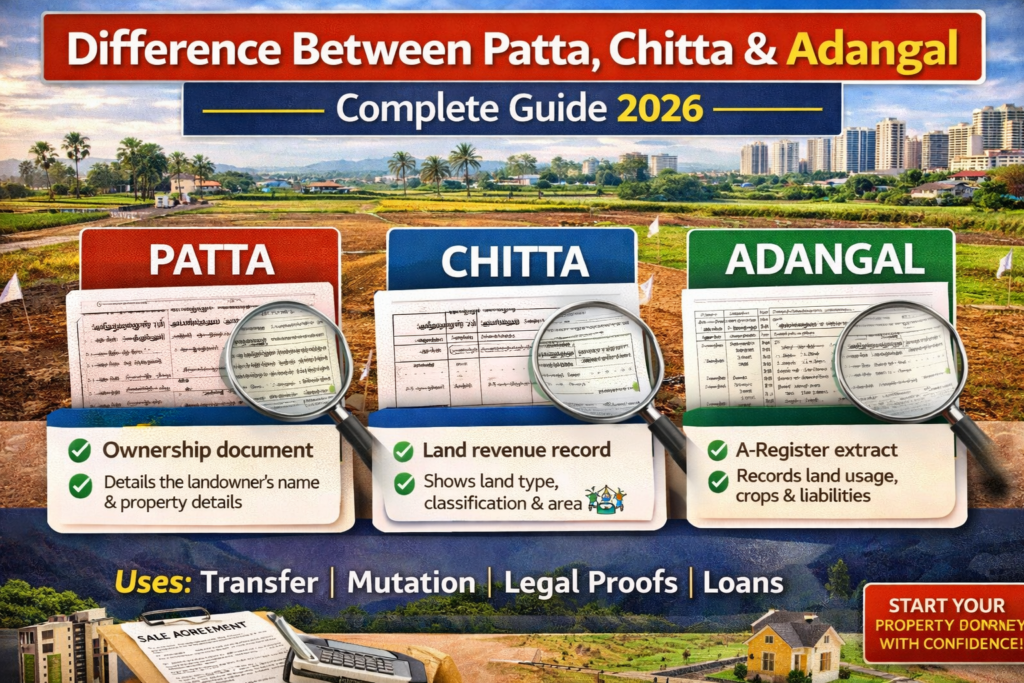
Patta, Chitta, and Adangal are land record terms most commonly used in Tamil Nadu — if you’ve searched for this comparison, here’s what each one means. But if you’re buying land in Andhra Pradesh specifically, the terminology is different, and that’s the part that actually matters for your purchase. This guide covers both.
What These Tamil Nadu Terms Mean
Patta is an official ownership record issued by the government in the property owner’s name, showing the owner’s name, survey number, land area, location, and land type. It’s the primary proof of ownership used in property registration, sale, and loan applications in Tamil Nadu.
Chitta is a land revenue document showing land classification—specifically whether it’s wet land (Nanjai) or dry land (Punjai)—along with the survey number and village details. It matters for agricultural and legal verification purposes.
Adangal (also used in Andhra Pradesh, under a related system) is a detailed record maintained at the village level, showing land usage, crop details, and tenancy information. It’s used for agricultural loan applications and dispute resolution.
Comparison: Patta vs. Chitta vs. Adangal
| Feature | Patta | Chitta | Adangal |
|---|---|---|---|
| Purpose | Ownership proof | Land classification | Land usage details |
| Key Info | Owner name, survey number, area | Wet/dry land classification | Crop and usage details |
| Required for Sale | Yes | Yes | Sometimes |
What Actually Applies in Andhra Pradesh
This is the part most guides on this topic skip. Andhra Pradesh doesn’t use “Patta” and “Chitta” as the primary land record terms — here’s what you’ll actually encounter:
Pattadar Passbook — the AP equivalent of Patta, this is the ownership record issued to the “pattadar” (landholder), typically for agricultural land, showing ownership and extent details.
Adangal — used in AP too, in a broadly similar sense to Tamil Nadu: a village-level record of land usage and cultivation details, maintained and accessible through the Meebhoomi portal.
1-B (Register of Land Records / ROR) — the AP document that functions closest to Tamil Nadu’s Chitta, showing land classification, extent, and revenue details tied to a specific survey number. This is one of the core documents we check during any agricultural-land verification in Vizag and Vizianagaram.
If you’re verifying agricultural-origin land in Andhra Pradesh—including land that’s since been converted for residential layouts—Adangal and 1-B records are what you should actually be requesting, not Patta and Chitta.
How to Verify These Records in Andhra Pradesh
- Go to the Meebhoomi portal, Andhra Pradesh’s official land records website.
- Select district, mandal, and village.
- Enter the survey number to pull Adangal and 1-B details.
- Cross-check the owner’s name and extent against the sale deed and EC you’ve already collected.
- For non-agricultural (converted/residential) land, also confirm the land-use conversion order exists — this matters when the land’s origin was agricultural.
Why This Distinction Matters for Buyers
Getting the terminology right isn’t just pedantic — it determines which government portal and which document you should actually be asking for. A buyer who searches for “Patta” while trying to verify land in Anandapuram or Kothavalasa is looking in the wrong system entirely; the AP equivalents (Adangal, 1-B, Pattadar Passbook) are what will actually show up in official AP land records.
Common Mistakes
- Asking for “Patta” on AP land — request the Pattadar Passbook and 1-B instead.
- Skipping the Adangal check on agricultural-origin land being sold for residential use.
- Trusting a broker’s verbal description of land classification instead of pulling the 1-B record directly.
- Not confirming land-use conversion when agricultural land is being sold as a residential plot.
An Illustrative Example
(This is a hypothetical scenario, not an actual transaction.)
Suppose a buyer is evaluating a plot near Pendurthi that was originally agricultural land. The seller presents a sale deed showing it as residential. Pulling the 1-B record through Meebhoomi reveals the land is still classified as agricultural in revenue records, with no conversion order on file — meaning residential registration could be blocked or later challenged. Catching this at the 1-B stage, before any advance payment, is exactly what this verification step is for.
Frequently Asked Questions
Is a Patta the same as a Pattadar Passbook? They serve a similar ownership-proof function but come from different state systems — Patta is Tamil Nadu terminology; Pattadar Passbook is the Andhra Pradesh equivalent. They aren’t interchangeable documents.
Does Andhra Pradesh use Chitta? Not under that name — the closest equivalent function is served by the 1-B / Register of Land Records.
Is Adangal used in both Tamil Nadu and Andhra Pradesh? Yes, both states maintain an Adangal-style village-level land usage record, though the exact format and access process differ.
Where do I check these records for land in Vizag or Vizianagaram? Through the Meebhoomi portal, using the survey number, district, mandal, and village.
Can I buy AP land without checking the 1-B record? It’s genuinely risky for agricultural-origin land specifically — the 1-B is often where classification and conversion status issues first show up.
The Bottom Line
If you found this page searching for Patta, Chitta, and Adangal, now you know what they mean — and if you’re actually buying land in Andhra Pradesh, Adangal, 1-B, and the Pattadar Passbook are the real documents to request. If you’d like help verifying agricultural-origin land in the Vizag area, get in touch.